

How do I know if my garbage disposal needs repair or full replacement?
Signs Your Garbage Disposal Is Giving You Trouble
Free Estimate
Your garbage disposal has a way of talking to you. It doesn't use words, but it sends clear signals. Think of the weird sounds, the odd smells, or things just slowing down. These are all clues. A lot of folks tend to ignore these early warnings. Weeks go by. Then a simple garbage disposal repair job in Oviedo can suddenly turn into a big mess under your sink.
We take calls every week from Orlando homeowners. They usually say something like, "It made a funny noise for a while, but I just kept using it." We get it. Life moves fast. But catching these signs early? That saves you money and a whole lot of frustration down the line.
Here's what our plumbers always tell people to watch out for:
- Grinding sounds change. A healthy disposal hums a steady tune. A struggling one might screech, rattle, or clank, like metal hitting metal. This means something's stuck inside, or the parts are just worn out. It's a clear warning.
- Water drains slowly. You run the disposal. Your sink fills right up. This tells us the unit isn't breaking down food bits the way it should. Maybe the blades are dull. Or maybe there's a bigger drain issue going on deeper in the pipes.
- Bad smells stick around. You've tried cleaning it. Ice cubes. Lemon peels. Hot water. Nothing works. The stink keeps coming back. This usually points to food trapped in spots the grinding parts can't reach anymore. It just sits there and rots.
- It just won't turn on. You flip the switch. Absolutely nothing happens. You try the red reset button on the bottom. Still no action. This often means an electrical problem. Sometimes the motor itself has just given up.
- Water is leaking underneath. A puddle in the cabinet below your sink is a real problem. The water could be coming from the top connection, a pipe on the side, or even from the body of the unit itself. It needs attention.
Checking the Reset Button
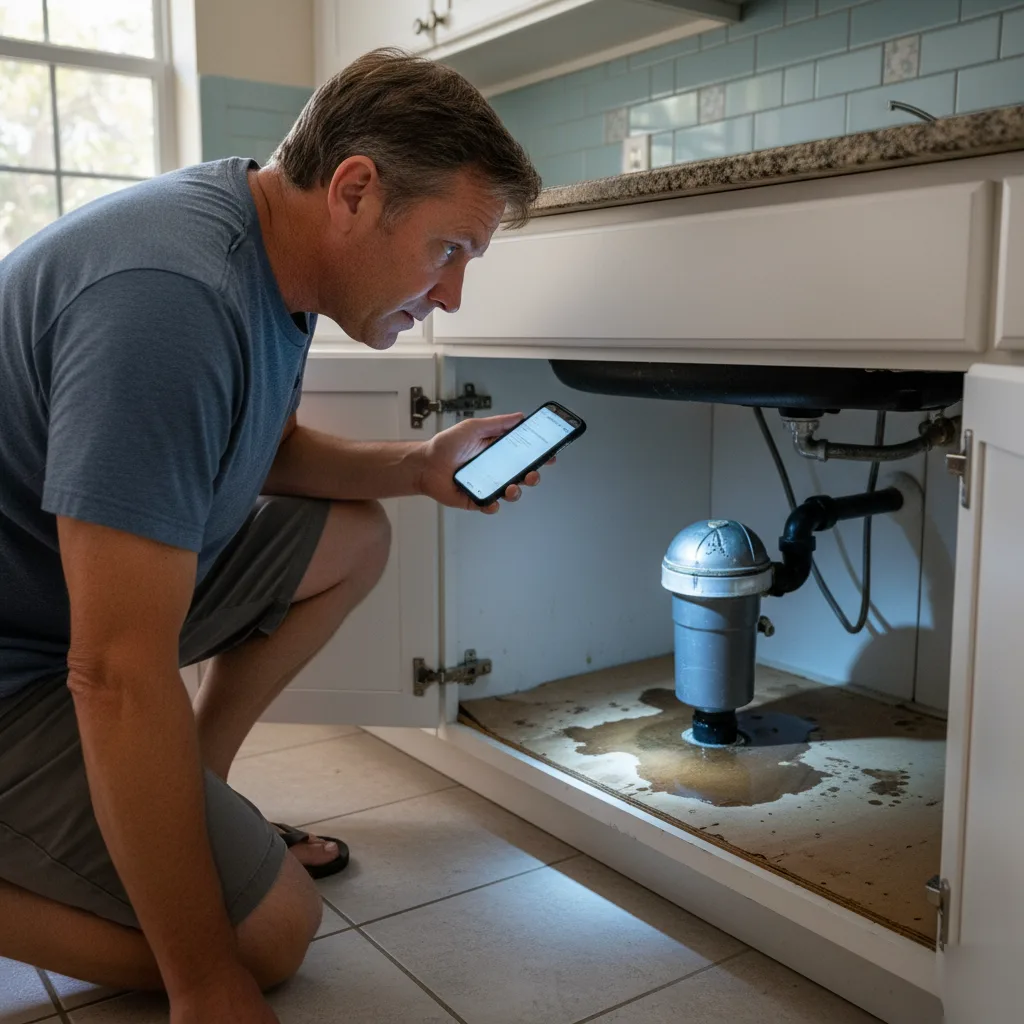
Every garbage disposal unit has a small reset button. It's usually red or black. You'll find it right on the bottom. This button acts like a mini circuit breaker for the unit. If your disposal suddenly cuts out, push it once. Then try the switch again.
Here's a little secret most people don't know: if you're hitting that reset button more often than once a month, your disposal is trying to tell you something. It's either overloaded or it's starting to fail. Pushing it after a serious jam is fine, no big deal. But if it's constant? That motor is just not keeping up anymore.
Orlando's Hard Water Problem and Your Disposal
Orlando's water is pretty hard, you know? It's full of minerals. Over time, those minerals build up inside your plumbing fixtures. Your garbage disposal is definitely not immune to this. Scale starts to coat the walls of the grinding chamber. It gets everywhere. This build-up makes the unit less effective at breaking down food scraps. We see this often in the older homes around the Waterford Lakes and Avalon Park areas. Many of those disposals have been chugging along for eight or ten years. Most homeowners haven't given them a second thought.
Hard water alone usually won't kill your disposal overnight. But it certainly speeds up the wear on all the internal moving parts, especially if you use it a lot every day. And many people do. That constant abrasion from scale just grinds everything down faster. It's a tough environment for any appliance.
So, how do you figure out if a warning sign means you need a repair or a brand new unit? A lot depends on how old your disposal is. It also depends on what the actual problem turns out to be. A simple jam or a reset issue is often a straightforward garbage disposal repair. But a cracked housing, or a motor that's just dead? That usually points to a full replacement. And if you've got a persistent leak coming from the main body of the unit, it's almost always time for a new one. Don't waste money fixing something that's on its last leg.
If you're seeing any of these signs, please don't wait. Don't let it completely lock up. Don't wait until it starts leaking all over your cabinet floor. Brightwater Plumbing of Oviedo handles garbage disposal repair all over Orlando. We can tell you exactly what's going on once we get a look at it. You can learn more about our garbage disposal services right here. We offer same-day help when you call us before noon.
Where the Leak Is Tells a Story: Repair or Replace?
Not every leak is the same. The exact spot where water shows up tells us a lot about what's actually happening inside your garbage disposal. Some leaks are easy fixes. Others mean the unit is completely done for. No amount of patching will save it.
We get phone calls about this all the time from folks in Tuscawilla and Alafaya Woods. They open the cabinet under their sink. They see a puddle. They assume the worst. But the first thing we always check is the precise source of that water. It changes everything.
Top of the Unit Leaks
If water is dripping from the very top of the unit, it usually means one of two things. Either the mounting ring is loose, or the sink flange itself has failed. That's the part that connects your disposal right to the sink drain. Over time, the constant vibrations from the disposal working can loosen those bolts. The plumber's putty also dries out and cracks. Then water starts to drip down the side of the unit. Good news here: this is almost always a straightforward garbage disposal repair. It's not a full replacement job. We simply tighten up the mount, re-seal the flange, and that leak usually stops completely. Easy enough.
One detail to keep in mind: if the flange itself is badly corroded, a new seal won't hold no matter how much fresh putty we use. We see this more often in older Orlando homes, especially in Seminole County. That hard water eats away at metal connections for years, and garbage disposals take a beating.
Side of the Unit Leaks
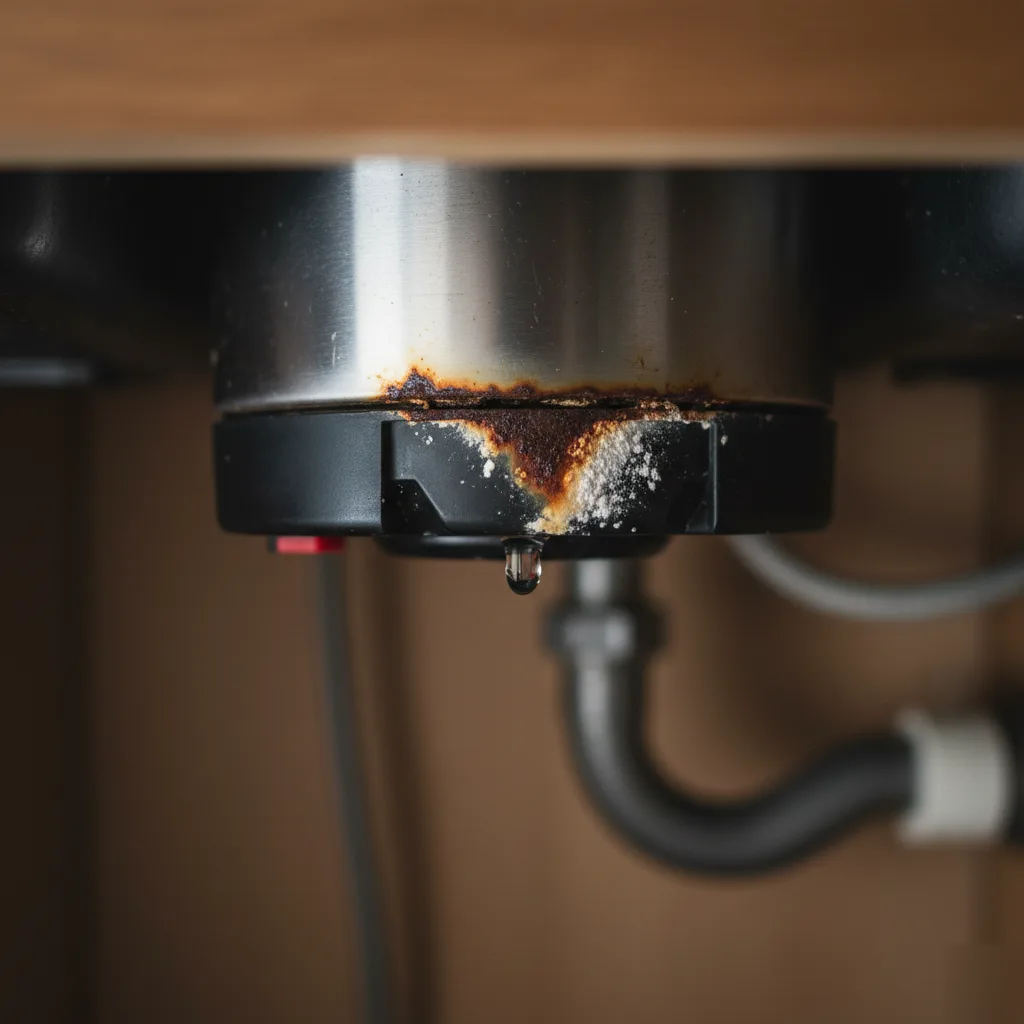
Leaks coming from the side of your disposal usually pop up from a couple of common places:
- The connection for your dishwasher inlet hose.
- The main drain pipe connection, which is where all the wastewater leaves the disposal.
- A cracked or just worn-out rubber gasket inside that discharge pipe.
These connections rely on rubber gaskets and metal clamps to hold tight. Gaskets wear out. Clamps loosen up. A side leak is typically repairable. We'll swap out the old gasket, tighten the clamp, and then run some water to test it. This job usually takes us about thirty minutes on most units. But if the housing itself has cracked where a connection meets the body of the disposal, that's a much bigger problem. You can't patch a cracked plastic or metal housing. It's just not going to hold.
Bottom of the Unit Leaks
This is the news nobody wants to hear. If water is leaking from the very bottom of your garbage disposal, it almost always means the internal seals have completely failed. Water is getting past the motor shaft seal. It's dripping right out the base of the unit. You can't really replace those seals without taking apart the entire motor assembly. And even then, that kind of repair rarely lasts very long. It's a lot of work for a.
Bottom leaks mean one thing: it's time for a full garbage disposal replacement.
We notice this a lot in homes built in the 1980s and 1990s around the Oviedo area. The original disposal might have been running for 15 or 20 years. Those internal seals finally give out. You start with a slow drip. That drip often turns into a steady stream. Most people don't even catch it until there's real water damage to the cabinet floor. Mold starts to grow. It becomes a bigger issue than just the disposal.
Here's a simple trick to find out where your leak is coming from. Dry off everything under your sink. Get it bone dry. Then plug the drain. Fill your sink basin up halfway with water. Add a few drops of food coloring, any color works. Then pull the plug. Watch carefully. The colored water makes it much easier to trace the exact path of the leak. You'll see it immediately.
So, before you start to panic over a puddle under the sink, check the location of the leak. Top and side leaks are often straightforward garbage disposal repair jobs. But leaks from the bottom usually signal it's time for a replacement. If you're unsure what you're looking at, our garbage disposal repair service is here to help. That's exactly what we do. We'll tell you straight: is it worth fixing, or does a new unit make more sense for your home?
Age Isn't Just a Number for Your Disposal; It's a Deadline
A garbage disposal can look perfectly fine from the outside. Yet it could be falling apart on the inside. We see this scenario play out constantly in Tuscawilla and Alafaya Woods homes, especially those built in the 1980s and 1990s. The unit sits quietly under the sink, looking clean enough. But those internal grinding components? They're worn smooth. The motor might be pulling way more power than it should. And then, one regular morning, it just stops cold. No warning. Just silence.
Most garbage disposals are built to last about 8 to 12 years. That's the general lifespan, according to folks like the International Association of Certified Home Inspectors. But here in Seminole County, our notoriously hard water often shortens that lifespan. Those minerals build up inside the grinding chamber. They coat the impellers. They corrode metal parts way faster than you might think. It’s just the nature of our water here.
So, how can you figure out the actual age of your unit?
How to Find Out Your Unit's Age
Look for a sticker or a stamped plate. It's usually on the bottom or the side of the disposal. You're searching for a serial number or a date code. Most manufacturers embed the year right into that serial number sequence. If the sticker is completely gone, or if it's too corroded to read, that tells you something important too. A label that's totally eaten away usually means your unit is well past its expected prime. It’s seen a lot of hard water. It’s done its job.
Here’s a simple way to think about where your disposal stands in its life cycle:
- Under 5 years old: A garbage disposal repair is almost always the smart choice. Parts are readily available. The motor still has plenty of life left in it. We can usually get it back to work quickly.
- Between 5 and 8 years old: Repair still makes sense for simpler problems, things like a quick jam or a reset issue. But if the motor hums without actually spinning, that’s a red flag. You should start planning ahead.
- Between 8 and 12 years old: If you're having frequent problems at this age, the unit is definitely wearing out. Repair costs can stack up really fast. You start throwing good money after bad.
- Over 12 years old: A full replacement is almost always the smarter move. Even if it seems to be running today. It's just borrowed time.
We've pulled some old disposals out of homes near Oviedo on the Park. Some were original to the house. The homeowner had no idea the unit was 15 years old, mostly because it "still worked." And yes, it did work, barely. But it was also leaking slowly from the bottom seal into the cabinet below. Mold had already started growing on the wood. Not a good situation.
Age Isn't Just About Breaking Down
Older disposals use a lot more electricity. They jam more often too. They grind food less completely, which can lead to more clogs in your drain line further down the pipe. And replacement parts for units older than 10 years? Those can be really tough to find, or sometimes they've been discontinued entirely. That's the part that catches most people off guard until it's already too late.
A garbage disposal repair on a newer unit might just cost you one visit from us. No big deal. But that same repair on a 12-year-old unit? It might fix today's problem, but then you'll likely be calling us again in three months for something else. We've seen homeowners in the UCF and Alafaya corridor go through two or three service calls on an old, failing disposal in a single year. All those repair visits added up to more than a brand new unit would have cost from the very beginning. It’s usually not worth the headache and repeat visits.
If you're unsure how old your disposal is, or if you've been dealing with the same issue more than once, our garbage disposal repair page can show you exactly what Brightwater Plumbing of Oviedo can do for you. Sometimes, the honest answer is that a repair will buy you another year or so. Other times, you're just better off starting fresh with a reliable, new unit. We'll tell you straight which choice makes the most sense for your home and your wallet.
Get a Free Quote!
Terms and Conditions
Request a Quote
Terms and Conditions
Request a Quote
Terms and Conditions