

How To Spot Hidden Plumbing Problems Before Buying a House
Orlando's trusted plumber for fast, honest service you can count on.
Free Estimate
Knowing how to spot hidden plumbing problems before buying a house can save you thousands in surprise repairs after closing. Check under every sink, around toilets, and near the water heater for stains, rust, or soft drywall — these are the clearest early warnings. Run every faucet, flush every toilet, and pay attention to water pressure. Low flow or slow drains in multiple rooms often point to bigger issues inside the walls or underground. Older homes may still have galvanized steel or cast iron pipes that corrode silently, and the sandy soil common in the Winter Garden area can cause underground pipes to shift and separate over time. A licensed Orlando plumber using a sewer camera inspection can find problems no visual walkthrough will ever catch.
What Are the Most Common Hidden Plumbing Problems in Older Homes?
The most common hidden plumbing problems in older homes are corroded pipes, slow drains, leaking shutoff valves, failing water heaters, and deteriorating sewer lines. Older homes, especially mid-century builds common in communities near Winter Garden like Orlovista, may still have galvanized steel or cast iron pipes that rust from the inside out.
Galvanized steel pipes corrode internally, reducing water flow and eventually flaking rust into the water supply — with no visible clue on the outside. The pipe's exterior can look perfectly intact while the interior is nearly blocked with rust scale, and nothing about the outside surface gives that away.
Cast iron drain lines crack and root-intrude over decades. The damage is usually underground and invisible during a basic walkthrough. Failing shutoff valves under sinks and behind toilets seize up or weep slowly, and sellers rarely disclose them because the valves seem minor — right up until one fails completely during an emergency.
Water heaters past their expected service life may look fine on the outside. A corroded anode rod — a sacrificial metal rod inside the tank that slows corrosion — can accelerate tank failure long before the exterior shows any sign of trouble.
What Pipe Materials Are Most Likely to Fail?
Galvanized steel, cast iron, and polybutylene are the materials most likely to cause serious problems in older Florida homes. Copper and PVC are the preferred modern replacements, but even copper can pit-corrode in areas with aggressive water chemistry.
Watch for these five warning signs of aging or failing pipe materials:
- Brown or rust-colored water from any faucet, especially after the water has sat unused overnight
- White or green mineral crust at copper pipe joints, which signals active corrosion or a slow drip
- Gray plastic pipe running through walls or utility areas, which may be polybutylene — a material known to fail at fittings without warning
- Flaking or pitting on visible pipe sections in the crawl space, basement, or utility room
- Low water pressure throughout the house, not just at one fixture, which can mean rust scale has built up inside the supply lines
How Do You Check Water Pressure During a Home Walkthrough?
To check water pressure during a walkthrough, turn on two or three faucets at the same time and flush a toilet. A sharp pressure drop signals a problem with the supply line or main. A licensed plumber can measure exact PSI with a gauge if there's reason to suspect the pressure regulator has failed. Anything noticeably weak or inconsistent deserves follow-up.
Run the kitchen faucet while someone flushes a toilet upstairs. If the shower trickles to almost nothing, the supply piping may be undersized or heavily corroded inside. Check every faucet individually after that — a single low-flow fixture can point to a localized blockage or a failing valve rather than a whole-house supply problem.
Very high pressure is also a problem. It stresses pipe joints and appliance connections and can shorten a water heater's life significantly. A pressure regulator — the valve that controls incoming water pressure from the street — can fail and let pressure creep well above safe levels, and most buyers never think to check for it.
What Does Low Water Pressure Actually Mean?
Low water pressure comes from two different places: the supply side or the demand side. Supply-side causes include corroded pipes that have narrowed internally, a failing water main connection, or a partially closed main shutoff valve. Demand-side causes include clogged aerators on individual faucets, a failed pressure regulator, or an undersized supply line that can't keep up when multiple fixtures run at once.
These four steps let you test pressure on a walkthrough without any special tools:
- Turn on the kitchen faucet fully and note the flow strength.
- Without turning the kitchen faucet off, flush the nearest toilet and watch whether kitchen flow drops noticeably.
- Turn on a bathroom sink, the shower, and the kitchen faucet simultaneously and hold them all open for 30 seconds.
- Check each fixture individually after the simultaneous test. Any fixture that performs worse alone than it did at first may have a valve or aerator problem specific to that location.
What Do Water Stains and Soft Spots Tell You About Hidden Leaks?
Water stains on ceilings, walls, or cabinet floors almost always mean a leak has happened. Fresh stains are darker and feel damp; old ones are yellowed and dry but still signal recurring problems. Press gently on drywall near stains. Soft or spongy material means moisture has soaked in long enough to start breaking down the wall structure behind the surface.
Check under every sink cabinet carefully, including the back corners where slow drips collect unseen for months. That back corner is one of the most common spots for a supply-line drip to go unnoticed until the cabinet floor rots through — and by then the repair reaches well beyond the plumbing alone.
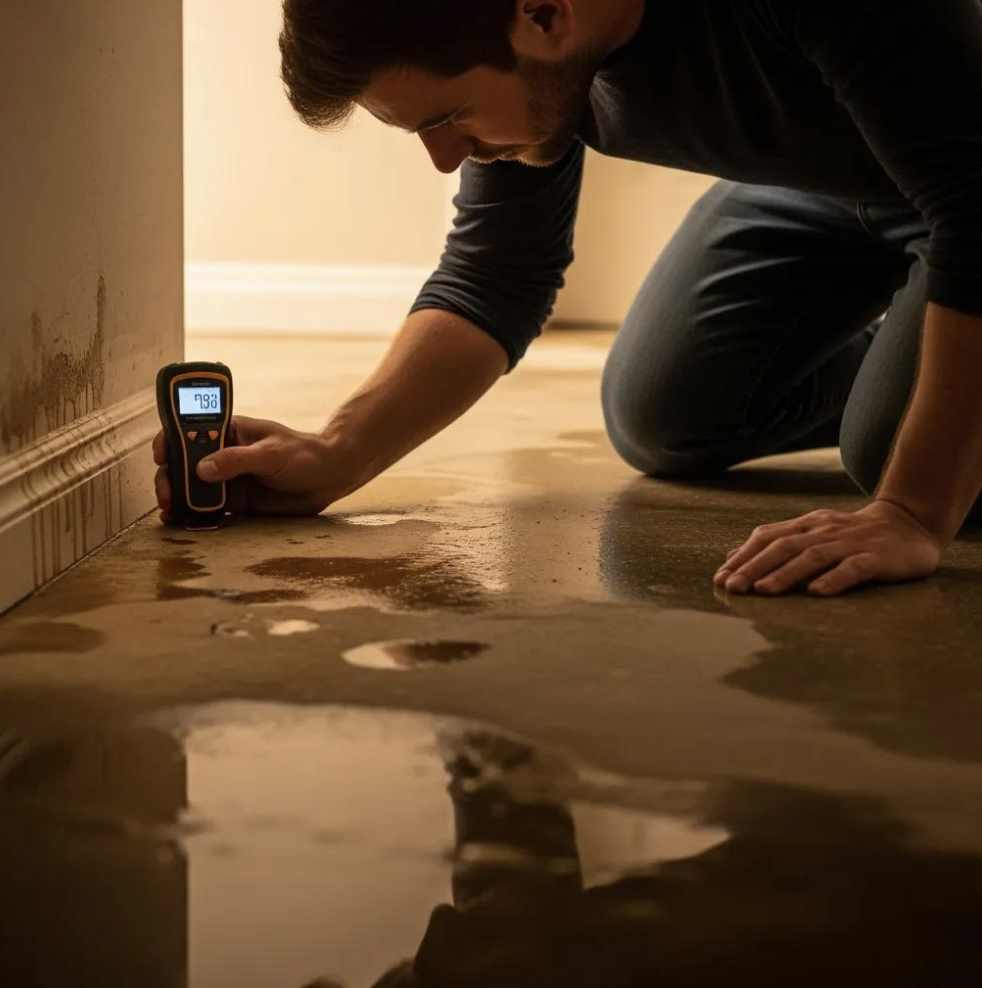
Look at bathroom floors near the toilet base and tub surround. A discolored or slightly springy floor can mean water has been wicking under the subfloor, which gets more expensive to fix the longer the moisture sits. Peeling paint or bubbled wallpaper along a wall that shares space with a shower or tub is a reliable sign of a slow plumbing leak behind the surface.
Florida's warm, humid climate can make it hard to tell condensation from an active leak. Press a dry paper towel flat against the suspect surface and hold it there for 60 seconds. A truly dry surface leaves the towel dry; an active leak or serious condensation source will transfer visible moisture to the paper.
How Do You Tell a New Leak From an Old One?
Color, texture, and smell separate active leaks from repaired or old ones. A new or active leak produces a stain that's dark brown or gray and feels cool and damp to the touch. An old, dried stain is yellow or tan, feels the same temperature as the surrounding surface, and has a clearly defined edge where minerals have deposited.
A musty or mildew smell near a stain that looks dry is a strong indicator that moisture is still present inside the wall cavity, even if the surface has dried. According to the EPA's guidance on mold and moisture, mold can begin to grow inside a wall within 24 to 48 hours of water exposure — so a musty smell near any stain warrants a closer look before closing. Don't let a seller tell you it's "just an old stain."
How Can You Tell If a Home's Drain System Has Serious Problems?
A drain system with serious problems shows itself through slow drains in multiple rooms at once, gurgling sounds after flushing, sewage odors inside the house, or water backing up in low fixtures when others are used. One slow drain is usually a local clog. Multiple slow drains at the same time point to a blockage or collapse deeper in the main sewer line.
Fill every sink to the brim during your walkthrough, then release all of them at once. A healthy drain system handles that load without complaint. A compromised system gurgles, backs up in the lowest fixtures first, or drains slowly enough that the problem is obvious.
Flush every toilet and watch the bowl. Water that rises before draining, or drains sluggishly even without any visible debris, is a red flag for sewer line trouble farther down the line. A sulfur or sewage smell anywhere inside — even a faint one — can mean a dry trap, a cracked sewer line, or a failing wax ring under a toilet.
In older Winter Garden-area homes, roots from large trees find their way into clay or cast iron sewer lines over time. No amount of drain cleaning permanently fixes a root intrusion without a camera inspection that confirms the root entry point and the extent of damage. A snake clears the symptom; it doesn't fix the cause.
What Is the Difference Between a Drain Clog and a Sewer Line Problem?
A drain clog and a sewer line problem produce different symptoms, sit at different locations in the system, and require different repairs.
| Aspect | Drain Clog | Sewer Line Problem |
|---|---|---|
| Symptoms | One slow or blocked fixture | Multiple fixtures slow or backing up at once |
| Location | Inside the branch line serving one fixture | Main sewer line between house and street |
| Common cause | Hair, grease, or debris in the branch drain | Root intrusion, pipe belly, crack, or collapse |
| Typical resolution | Drain snaking or jetting the branch line | Sewer camera inspection, line jetting, or sewer line repair |
When the problem is isolated to a single fixture, a drain snake often clears it quickly. But when the problem spans multiple fixtures or reappears soon after being cleared, the issue almost certainly sits in the main sewer line and requires a camera inspection to diagnose accurately.
What Does a Sewer Camera Inspection Reveal That a Visual Check Misses?
A sewer camera inspection threads a small waterproof camera through the drain line and shows cracks, root intrusions, bellied pipe sections, and blockages that are completely invisible from the surface. A trained eye watching the live camera feed can identify pipe material, grade issues, partial collapses, and buildup — all before you sign a single document.
Root intrusion is the most common finding in older Florida neighborhoods. Roots enter hairline cracks in clay or cast iron lines and grow until they block flow entirely. The entry point is rarely at a cleanout or access point — it's almost always underground and inaccessible without camera equipment.
A "belly" in the sewer line is a low sag caused by soil movement that traps waste at the low point and causes chronic backups. It only shows up on camera because the sag can be just a few inches deep and the pipe above it looks perfectly level from any surface access point.
The inspection produces recorded footage you can use as a negotiating tool with the seller or as documentation for repair estimates. That footage gives you a concrete, specific item to put on the repair request — far stronger than a general inspector's note that "the drains seemed slow."
In the Winter Garden area, Orlando's sandy soil and frequent ground saturation can cause underground pipe shifting over time. That combination makes sewer camera inspections especially valuable here compared to areas with more stable soil conditions.
When Should You Schedule a Sewer Camera Inspection?
Schedule the sewer camera inspection after your offer is accepted and during your contract inspection contingency window. Florida purchase contracts typically include an inspection period — check your specific contract and confirm the exact timeframe with your real estate agent or attorney. A licensed plumber can typically complete a camera inspection within that window, but only if you call early in the contingency period, not the day before it expires.
If the seller has already disclosed prior sewer work, ask for permit records before scheduling the inspection. In the Orlando area, sewer line repairs and replacements require permits and must meet local building codes. Records that show the work was permitted and passed inspection give you confidence; their absence tells you something important about how the repair was handled.
Which Pipe Materials Should Raise a Red Flag in Older Florida Homes?
Galvanized steel, cast iron, and polybutylene pipes are the three materials most likely to cause serious problems in older Florida homes and should always trigger a closer inspection. Galvanized steel corrodes from the inside out — the pipe exterior can look intact while the interior is nearly blocked with rust scale, slashing water pressure and contaminating flow. The EPA guidelines on safe drinking water identify lead and corrosion byproducts from aging pipes as a drinking water concern worth monitoring.
Cast iron drain lines are common in mid-century builds and crack over decades. Florida's sandy soil shifting accelerates joint separation underground, making cast iron failures in this region faster-moving than in more stable soil conditions.
Polybutylene — a gray plastic pipe used in some homes built between the 1970s and mid-1990s — is known to fail without warning at fittings. The U.S. Consumer Product Safety Commission has documented polybutylene failures; any home with this material should be flagged for a full repipe evaluation before purchase. If you spot gray plastic pipe running through the walls or utility areas, that's worth stopping for.
Copper piping is generally reliable but can pit-corrode in areas with aggressive water chemistry. Look for green staining or white mineral crust at joints — both are signs that corrosion is active at the connection point.
Modern PVC and PEX installations are the least concerning materials, but even these require proper support and expansion allowances. Check that pipes aren't resting hard against framing or running unsupported over long horizontal spans.
What Does a Whole-House Repipe Involve?
A whole-house repipe replaces all supply lines — and sometimes drain lines — throughout the home with new pipe material, typically PEX or copper for supply and PVC for drains. A full repipe is the right call when galvanized steel or polybutylene supply lines are present throughout the house, when water pressure is low in every room, or when rust-colored water appears at multiple fixtures.
Spot repairs make sense when the problem is isolated to one or two sections of pipe and the rest of the system tests clean. A licensed plumber can assess which approach fits the actual condition of the home rather than defaulting to the more expensive option.
| Pipe Material | Common Failure Mode | Visual Clue | Recommended Action |
|---|---|---|---|
| Galvanized steel | Internal rust scale blocks flow | Brown water, low pressure everywhere | Full repipe evaluation |
| Cast iron | Cracking, root intrusion at joints | Slow drains, gurgling, sewer odor | Sewer camera inspection |
| Polybutylene | Fitting failure without warning | Gray plastic pipe throughout home | Full repipe evaluation |
| Copper | Pitting corrosion at joints | Green staining, white crust at fittings | Spot repair or joint replacement |
| PVC / PEX | Improper support or joint failure | Sagging runs, wet spots near joints | Visual inspection, support correction |
How Does Sandy Soil in the Winter Garden Area Affect Underground Plumbing?
Winter Garden sits on Orlando's characteristic sandy soil, which drains quickly after rain but also shifts and saturates easily. Both conditions can cause underground pipes to move, sag, or separate at joints over time. Sandy soil provides less stable support for buried pipes than clay-heavy soil does, and without firm bedding under and around the pipe, pipes settle unevenly and develop low spots that trap waste and promote backups.
Frequent ground saturation after Florida's heavy summer rain events puts upward pressure on lightweight sewer pipes. That upward pressure can cause lines to shift laterally or lift at connection points — a failure mode that only shows up on a camera inspection, never on a surface walkthrough.
Homebuyers looking at properties in Horizon West, Windermere, or downtown Winter Garden should treat underground plumbing as an unknown quantity until a camera inspection confirms otherwise. The soil conditions across the Winter Garden area are consistent enough that no older home should be assumed to have stable underground plumbing without verification.
Above-ground plumbing in Florida also faces stress from unpredictable temperature swings. Even mild cold snaps — the kind Florida homeowners often dismiss — can open micro-cracks at pipe joints already stressed by soil movement below. A pre-purchase plumbing inspection that covers both above-ground supply lines and below-ground drain and sewer lines gives the fullest picture of what a home actually needs before you commit to the purchase.
When Should You Bring In a Licensed Plumber Before Closing?
Bring in a licensed plumber before closing any time the general home inspector flags plumbing concerns, the home is more than 20 years old, or you notice any of the warning signs covered above. A general home inspector checks visible conditions and uses the fixtures under normal use. A licensed plumber can pull access panels, run equipment under load, and perform a sewer camera inspection that a general inspector typically can't.
Schedule the plumbing inspection during your contract inspection window so findings can become part of your repair request or price negotiation before you're committed to close. Waiting until after the inspection window expires removes your ability to use those findings in any negotiation, and that window closes faster than most buyers expect.
If the seller has already disclosed plumbing repairs, ask for permits and signed-off inspection records. In the Orlando area, sewer work and major plumbing installations require permits and must meet local building codes. Records that show the work was permitted and passed inspection give you confidence; their absence tells you something important about how the repair was handled.
A licensed, insured plumber documents what they find in writing. That report protects you whether you negotiate repairs, walk away from the deal, or buy the home as-is with full knowledge of what you're taking on.
Same-day availability matters during the inspection window. Inspection periods are short, and you need a plumber who answers the phone and can schedule quickly — including evenings and weekends if the contract timeline is tight.
What Should a Pre-Purchase Plumbing Inspection Cover?
A thorough pre-purchase plumbing inspection should address every major system in the home, not just the fixtures that look suspicious. Ask your licensed plumber to evaluate all six of the following:
- Supply lines and pipe materials — identify galvanized steel, cast iron, polybutylene, or any other material that warrants closer evaluation or replacement planning.
- Drain system performance — run all fixtures simultaneously and document drain speed, gurgling, and any backup at low points.
- Water heater age and condition — check the manufacture date on the data plate, inspect the anode rod access if possible, and note any rust or mineral buildup at connections.
- Sewer camera inspection — thread the camera through the main sewer line and record footage showing pipe condition, any root intrusion, bellied sections, or cracks.
- Shutoff valves — test every shutoff valve under sinks, behind toilets, and at the main to confirm each valve opens and closes fully without seizing.
- Visible fixtures and connections — inspect faucets, toilet bases, tub surrounds, and supply connections for active leaks, corrosion, or improper repairs.
If you're looking for a licensed plumber in Winter Garden to complete a pre-purchase inspection, Brightwater Plumbing of Orlando is a family-owned, locally operated team that answers the phone — including evenings and weekends — and provides written findings you can take straight to your real estate agent.
The Bottom Line
Hidden plumbing problems — corroded pipes, failing sewer lines, slow drains, and active leaks — rarely show up on a casual walkthrough. Older homes and the sandy soil conditions across the Winter Garden area make underground and aging-pipe problems especially common here, and a sewer camera inspection is worth every dollar before any purchase. Finding problems before closing gives you negotiating power. Finding them after closing gives you a repair bill.
Get a Free Quote!
Terms and Conditions
Request a Quote
Terms and Conditions
Request a Quote
Terms and Conditions